Recently, a research team led by Prof. Ling Chongyi, Prof. Wang Jinlan and Associate Prof. Li Qiang from the School of Physics, SEU, has achieved new breakthroughs in the dynamic evolution mechanism of catalysts. Relevant findings were published inJournal of the American Chemical Society (JACS), a top international chemistry journal, under the title “Revisiting Catalyst Restructuring in CO₂ Reduction: The Dominant Yet Overlooked Role of Hydrogen”.
Copper (Cu) is the only known monometallic catalyst that can efficiently convert carbon dioxide into high-value-added multi-carbon products. Its superior performance is closely associated with dynamic surface restructuring under reaction conditions. Nevertheless, the fundamental driving force behind such structural evolution has long been controversial. The mainstream view holds that surface restructuring is mainly induced by the adsorption of reaction intermediates, especially carbon monoxide (CO). However, this interpretation is not fully consistent with experimental observations: within the potential range where obvious restructuring is detected, the surface coverage of CO is generally below 5% with weak adsorption strength, which is insufficient to overcome the high energy barrier for copper dissolution.
To address this issue, the research team conducted systematic theoretical simulations and shifted its focus to adsorbed hydrogen (*H), a ubiquitous species in aqueous electrochemical environments that has long been overlooked due to spectral overlap with adsorbed *CO. By combining first-principles density functional theory (DFT) calculations with an explicit solvation model and ab initio molecular dynamics (AIMD) simulations, the team proposed a unified hydrogen-activated restructuring mechanism for the first time. This mechanism confirms that adsorbed hydrogen is the dominant driver of catalyst dynamic restructuring, offering a new theoretical framework for interpreting the underlying processes.
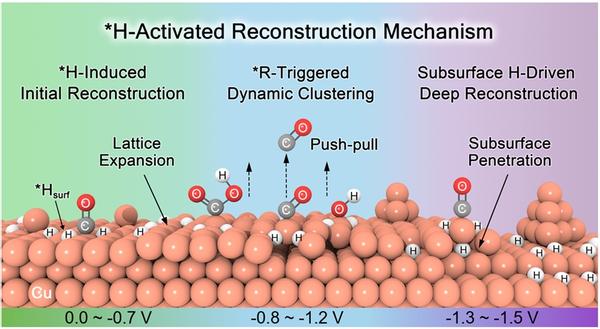
The study reveals that adsorbed hydrogen strengthens antibonding orbital interactions via electron injection and induces substantial lattice expansion, putting the metal surface in a loosely “pre-activated” state and drastically lowering the kinetic energy barrier for atomic leaching. The catalyst restructuring proceeds in distinct stages as the potential varies. At low overpotentials, surface adsorbed hydrogen first triggers local lattice distortion. As the coverage of CO₂ reduction reaction intermediates (*R) increases, the pre-loosening effect of *H synergizes with the traction effect of intermediates, facilitating the leaching and re-aggregation of a large number of metal atoms to form highly active low-coordination clusters. At more negative potentials, hydrogen further penetrates into the subsurface (*Hsub). The internal pressure generated by subsurface hydrogen, together with the external pulling force from surface intermediates, creates a “push-pull” effect and drives further structural transformation. The continuous dissolution-redeposition cycle generates abundant defective sites, which are verified to greatly reduce the C–C coupling energy barrier (e.g., the CO coupling barrier drops to 0.43 eV), serving as the genuine highly active reaction centers.
Furthermore, the research team extended this mechanism to various metallic systems including gold (Au), silver (Ag), platinum (Pt), nickel (Ni) and iridium (Ir). A universal thermodynamic descriptor, the average adsorbed atom formation energy (¯ΔEform), was established to predict the stability trends of metal catalysts in complex electrochemical environments, and the predictions are in excellent agreement with experimental results. The research also demonstrates that surface alloying with metals such as iridium (Ir), which possess a high hydrogen penetration energy barrier, can effectively inhibit subsurface hydrogen permeation and markedly improve the long-term structural stability of catalysts. This work provides new theoretical foundations and design strategies for developing electrocatalytic materials with high activity and excellent stability.
The first author of the paper is Zhang Haona, a doctoral candidate at SEU. Prof. Ling Chongyi, Prof. Wang Jinlan and Associate Prof. Li Qiang from the School of Physics, SEU serve as the corresponding authors. This research was supported by the Excellent Young Scientists Fund and the Youth Program of the National Natural Science Foundation of China (NSFC).
Paper’s link: https://doi.org/10.1021/jacs.6c05573
Source: School of Physics, SEU
Translated by: Melody Zhang
Edited by: Leah Li