Recently, the research team led by Prof. Li Quan—Dean and Chief Scientist of the Intelligent Material Research Institute andfrom the School of Intelligent Science and Engineering, SEU—has published the latest findings in Nature Communications, a top international academic journal, under the title “Multistate photoswitches beyond on and off”.
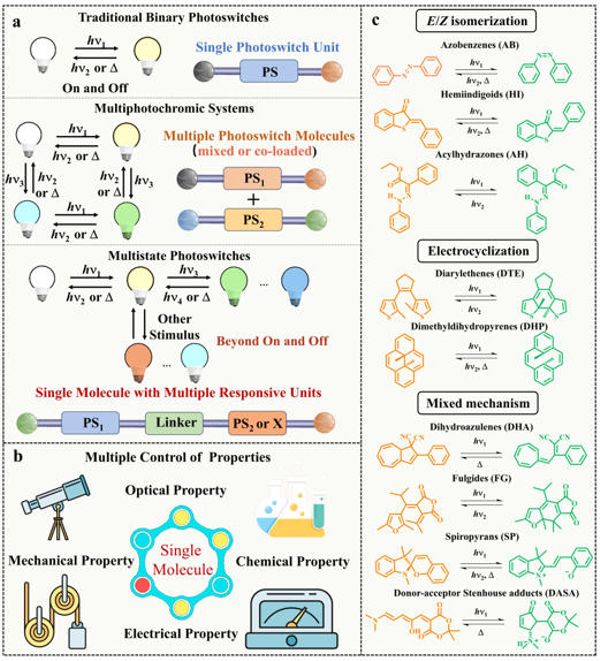
Molecular photoswitch materials enable precise control of structure and properties via light irradiation, showing great potential in intelligent devices, information storage, biomedicine, and other fields. However, conventional photoswitches are limited to only two states (“on” and “off”), restricting functional diversity andlimiting their suitability for complex applications. Multistate photoswitches break through the constraints of traditional binary systems, allowing reversible switching among three or more distinguishable states, thus endowing materials with higher functional complexity and control precision.
Building on previous research, Prof. Li Quan’s team systematically reviews the progress and future directions of the emerging field of multistate molecularphotoswitches, deeply analyzes the enhanced functional complexity and application versatility achieved by moving beyond binary states, comprehensively summarizes molecular design strategies and representative systems for realizing multistate behavior, and highlights cutting-edge applications in energy storage, multi-level information encryption and anti-counterfeiting, molecular machines, soft actuators, and biomedicine. Through interdisciplinary collaboration and technological innovation, the team has prospectively outlined key future directions for multistate molecularphotoswitches, which are expected to revolutionize responsive materials, information technology, and biomedicine, and open a new era of precise control at the molecular scale.
The first author of the paper is Xu Yang, a PhD candidate from the School of Chemistry and Chemical Engineering, SEU. The corresponding authors are Prof. Li Quan and Prof. Tang Yuqi. This research was supported by the Jiangsu “Entrepreneurship and Innovation Team” Program, the National Natural Science Foundation of China, the Jiangsu Natural Science Foundation, the China Postdoctoral Science Foundation, and other funding agencies.
Paper link:https://doi.org/10.1038/s41467-026-72726-9
Source: Wuxi Campus, SEU
Translated by: Melody Zhang
Proofread by: Gao Min
Edited by: Leah Li