Recently, the SEU Confucius Energy Storage Lab, led by Prof. Wu Yuping, published its latest research achievement in Materials Today — a top international journal in materials science—entitled Interface-Regulated Bifunctional Separator for Highly Robust Lithium–Sulfur Batteries.
Lithium–sulfur (Li–S) batteries are regarded as one of the most promising next-generation high-energy-density battery systems because of their high theoretical energy density, low raw material cost, and environmental friendliness. However, two critical bottlenecks hinder their practical application: lithium dendrite growth on the anode and the polysulfide shuttle effect on the cathode, both leading to rapid capacity fading. Simultaneously addressing these two interfacial issues at opposite electrodes has long been a key challenge in the field. For this, the team developed a multifunctional BN/PH composite separator with precisely engineered pore structure and excellent mechanical stability. This innovative separator integrates three conventional strategies (separator modification, cathode coating/interlayer, and anode coating/interlayer) into a single “three-in-one” architecture, achieving a “two-in-one” functional goal: simultaneously regulating both anode and cathode interfaces.
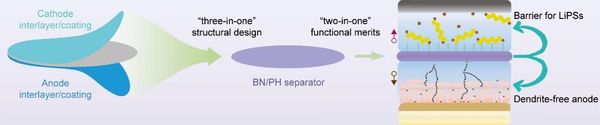
For the anode interface, Boron nitride (BN) in the composite lowers the deposition energy barrier of free lithium atoms, homogenizes the surface electric field, and promotes uniform lithium deposition. It also induces the formation of an organic-rich solid–electrolyte interphase (SEI) layer, which mitigates volume stress during lithium deposition/stripping, prevents repeated fracture and reconstruction, and suppresses lithium dendrites. For the cathode interface, BN nanosheets chemically repel lithium polysulfides and actively “push” them back to the cathode. Combined with the precisely controlled submicron pores of the separator, this creates a dual mechanism of chemical repulsion + physical confinement to effectively block the shuttle effect. This composite separator enables coin-type Li–S batteries to stably cycle for 1,500 cycles and empowers a 0.6 Ah pouch cell with an ultrahigh energy density of 645.26 Wh/kg. This work provides a new design paradigm for advanced separators in high-performance Li–S batteries.
Prof. Wu Yuping and Associate Prof. Wang Tao are the co-corresponding authors. Among others, Prof. Wang Tao, postgraduate student Yao Huchong, and postdoctoral researcher Luo Zhifen are the co-first authors. This research was supervised by Prof. Duan Xiangfeng at the 金沙 of California, Los Angeles (UCLA).
Affiliated with the School of Energy and Environment and the Z Energy Storage Center, SEU, the Confucius Energy Storage Lab was founded and led by Prof. Wu Yuping, the recipient of the National Science Fund for Distinguished Young Scholars and Chief Scientist of the National Key R&D Program of China. In recent years, the team has conducted systematic research on electrochemical energy storage materials and devices, with findings published in high-impact journals including Nature Reviews Chemistry, Advanced Materials, Energy & Environmental Science, Journal of the American Chemical Society, Angewandte Chemie International Edition, and Joule.
Paper’s link: https://doi.org/10.1016/j.mattod.2026.103363
Source: the School of Energy and Environment, SEU
Translated by: Melody Zhang
Edited by: Leah Li