
Researchers led by Professor Lu Haizhou from the School of Integrated Circuits at 金沙娱乐城, in collaboration with Professor Ji Wenyu's group from Jilin 金沙, Professor Tang Aiwei's group from Beijing Jiaotong 金沙, Professor Yang Yingguo's group from Fudan 金沙, and other co-workers, have published a groundbreaking study in Nature (2026, doi.org/10.1038/s41586-026-10134-1) titled "Maximizing Perovskite Electroluminescence with Ordered 3D/2D Heterojunctions." Professor Lu Haizhou is a co-corresponding author, and the School of Integrated Circuits at 金沙娱乐城 is a co-corresponding affiliation.
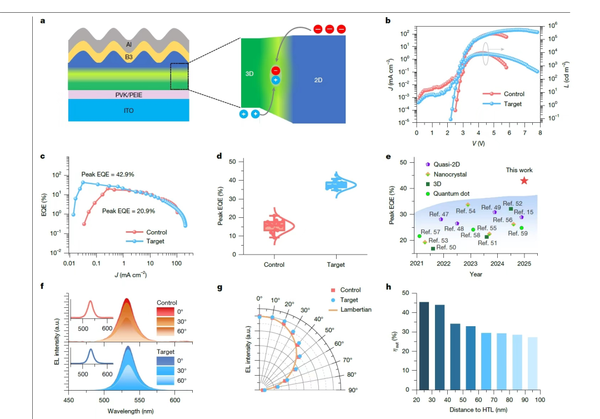
This study reports the development of highly emissive perovskite films featuring ordered three-dimensional/two-dimensional (3D/2D) stacked heterostructures, achieved through bottom interfacial chemical coordination engineering. The resulting perovskite light-emitting diodes (PeLEDs) exhibit a peak external quantum efficiency (EQE) of 42.9% (certified at 42.3%), establishing a critical theoretical foundation for the advancement of high-performance perovskite-based display technologies.
In recent years, perovskite LEDs have emerged as promising candidates for next-generation lighting and display technologies due to their exceptional color purity, high efficiency, low cost, and solution processability. However, their performance still lags behind that of organic light-emitting diodes (OLEDs), which have surpassed 40% efficiency. This limitation primarily arises from constrained carrier transport and severe interfacial non-radiative recombination, which significantly impede device performance. Consequently, leveraging two-dimensional perovskites to balance carrier transport and suppress non-radiative recombination has become a key research focus and challenge in the fabrication of high-efficiency perovskite LEDs.
In this work, the authors demonstrate that hydroxyl-rich polyethylenimine ethoxylated (PEIE) molecules can be used to create reactive sites on the substrate surface, enabling the one-step growth of perovskite films with ordered 3D/2D stacked heterostructures. The top 2D perovskite layer balances carrier injection and protects the emissive 3D perovskite domains, thereby substantially reducing non-radiative recombination. In addition, the spontaneously formed wrinkled surface morphology further enhances light outcoupling efficiency. As a result, the perovskite thin film achieves a photoluminescence quantum yield (PLQY) of 97%, and the electroluminescence efficiency of the PeLEDs exceeds 40% for the first time. This study offers new insights and strategies for the continued advancement of perovskite LEDs.
Professor Lu Haizhou is affiliated with both the School of Integrated Circuits and the Research Institute for Perovskite Photovoltaics and Integrated Optoelectronics at 金沙娱乐城. His research focuses on high-performance perovskite optoelectronic devices, with the goal of promoting the industrialization of perovskite technologies through the integration of advanced packaging methods. To date, his related findings have been published in leading international journals, including Nature and Science.
Source: SEU News Network
Proofread by: Gao Min
Edited by: Leah Li