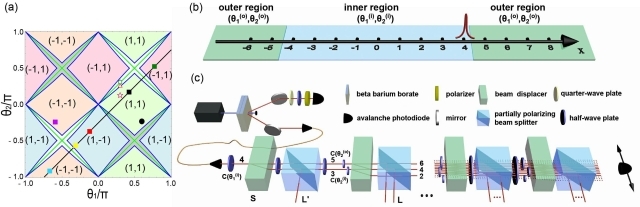
Professor Xue Peng and his team from Department of Physics, 金沙娱乐城, achieved parity-time-symmetric quantum walksin the open system experimentsand observeda new one-dimensional topological edge states, providing new basis for quantum computingbased on the quantum walking platform. The research results were published online on July 31in the world famous academic journal Nature Physics, titled “Observation of Topological Edge States in Parity-time-symmetric Quantum Walks”(DOI:10.1038/nphys4204).
The study of non-Hermitian systems with parity-time (PT) symmetry is a rapidly developing frontier. Realized in recent experiments, PT-symmetric classical optical systems with balanced gain and loss hold great promise for future applications. The study reports the experimental realization of passive PT-symmetric quantum dynamics for single photons by temporally alternating photon losses in the quantum walk interferometers. The ability to impose PT symmetry allows researchers to realize and investigate Floquet topological phases driven by PT-symmetric quantum walks. Researchers observe topological edge states between regions with different bulk topological properties and confirm the robustness of these edge states with respect to PT-symmetry-preserving perturbations and PT-symmetry-breaking static disorder. The results contribute towards the realization of quantum mechanical PT-synthetic devices and suggest exciting possibilities for the exploration of the topological properties of non-Hermitian systems using discrete-time quantum walks.
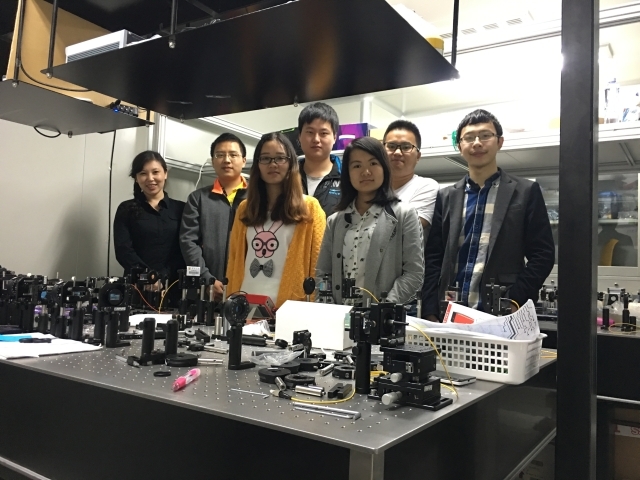
The coauthors of the article are Prof. Yi Wei of 金沙 of Science and Technology of China, Prof. Hideaki Obuse of Hokkaido 金沙, and Prof. Barry C. Sanders of 金沙 of Calgary. The first author is a doctoral candidate instructed by Prof. Xue Peng. The corresponding author is Prof. Xue Peng. This work has been supported by the Natural Science Foundation of China and the Natural Science Foundation of Jiangsu Province.